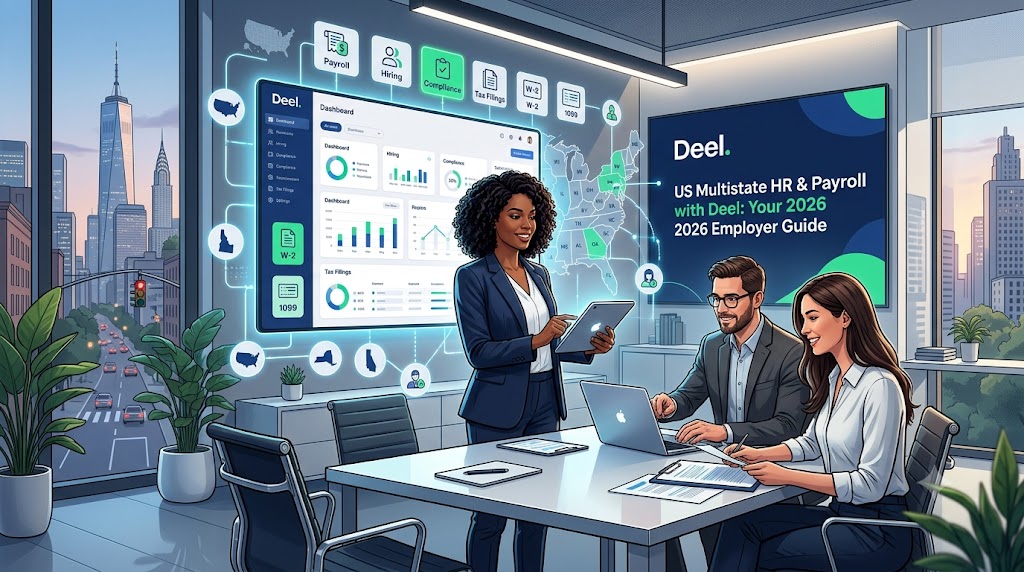
Managing a distributed workforce in the United States has become increasingly complex for employers. As remote and hybrid work models solidify, organizations no longer operate solely under the employment laws of their headquarters’ state. Instead, businesses must comply with a dizzying patchwork of federal, state, and local regulations.
In 2026, the regulatory environment is stricter than ever. Failing to navigate these intersecting laws leads to severe financial penalties, audits, and reputational damage. Fortunately, modern infrastructure like Deel simplifies this complexity. Deel acts as a unified global hiring and payroll engine, providing the compliance guardrails, automated tax filings, and localized HR tools that businesses need to manage a dispersed U.S. team safely and efficiently. This guide outlines the core challenges of multistate HR and payroll compliance and demonstrates how Deel provides the ultimate operational toolkit.
How Deel Streamlines Multistate Tax and Payroll Obligations
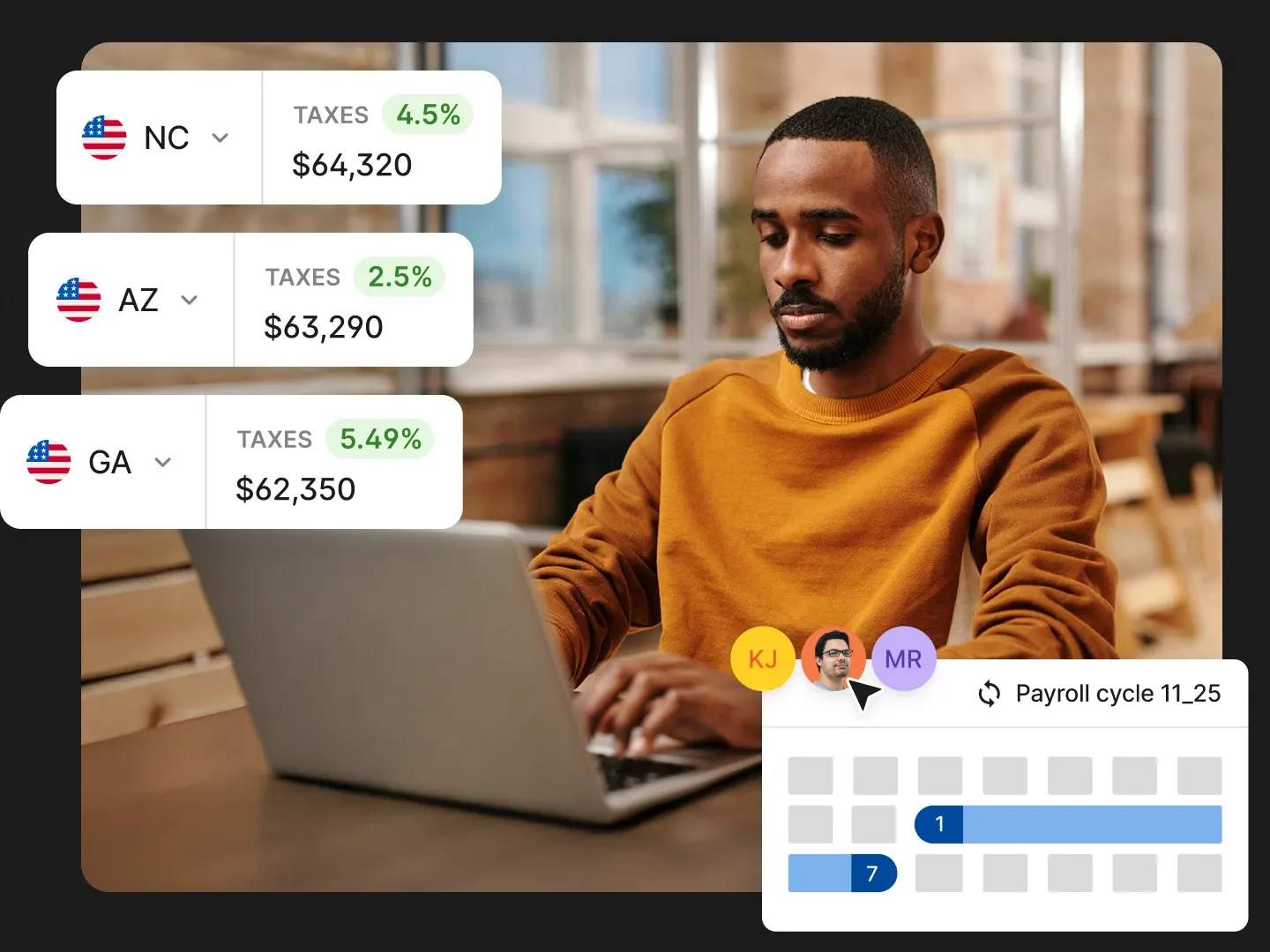
When employees reside or work in different states, payroll processing goes beyond simple federal tax withholding. Employers must register with state tax agencies in every jurisdiction where they have an employee performing work.
a. State Income Tax Withholding
Employers must withhold state and local income taxes based on the employee’s work location and sometimes their state of residence. Deel’s built-in payroll engine automates multi-jurisdictional tax calculations, ensuring that the correct state and local taxes are withheld from each paycheck automatically, eliminating manual spreadsheet errors.
b. Unemployment Insurance (SUI) Taxes
State Unemployment Insurance (SUI) rates vary significantly by state and employer history. Employers must pay SUI in the state where the employee physically works. Misclassifying an employee’s work state can result in massive tax discrepancies and penalties. Deel helps track employee locations and automates the registration and remittance of SUI taxes, keeping your organization compliant behind the scenes.
Navigating Expanding Pay Transparency Laws with Deel
Pay transparency is no longer a localized trend; it is a nationwide movement. A growing number of states and municipalities now require employers to disclose salary ranges in job postings and to current employees.
Key Requirements
-
Salary Ranges: Job advertisements must include a good-faith minimum and maximum salary or hourly wage.
-
Benefits Disclosure: Some jurisdictions also mandate the disclosure of bonuses, commissions, and benefits tied to the role.
-
Internal Transparency: Employers must often provide promotional opportunities and salary ranges to existing staff upon request or during performance reviews.
To remain compliant, organizations must adopt standardized compensation bands. Deel’s recruitment and onboarding modules allow HR teams to embed compliant compensation data directly into job descriptions dynamically, adjusting automatically based on the candidate’s specific regional laws.
AI Governance and Bias Audits in Hiring Decisions
The use of Artificial Intelligence (AI) and automated tools in recruitment, resume screening, and video interviewing has skyrocketed. However, regulators are cracking down on algorithmic bias.
Algorithmic Accountability
Several states mandate regular bias audits for automated employment decision tools (AEDTs). Employers must prove that their hiring software does not discriminate based on race, gender, age, or other protected characteristics. Furthermore, candidates must be notified if AI is being used to evaluate their application, and they often have the right to request human review. Deel ensures that your hiring stack maintains strict compliance, logging necessary disclosures and ensuring vendor tools meet state-level accountability standards.
Worker Classification: W-2 Employees vs. 1099 Independent Contractors via Deel
Misclassifying workers remains a top priority for the Department of Labor (DOL) and state tax authorities. The financial implications of getting this wrong are severe, including back pay for unpaid overtime, unpaid payroll taxes, and statutory penalties.
The “Economic Realities” Test
Federal and state agencies use multifactor tests to determine whether a worker is an employee (W-2) or an independent contractor (1099). Key factors include:
-
The degree of control the employer has over the work.
-
The worker’s opportunity for profit or loss.
-
The degree of independent business operation.
Because state definitions can be stricter than federal guidelines (such as California’s “ABC” test), employers must evaluate classification on a state-by-state basis. Deel mitigates this risk completely by offering built-in classification assessments, generating localized, compliant contractor agreements, and allowing you to seamlessly transition talent from 1099 contracts to W-2 employment—all within the same platform.
Evolving State-Specific Paid Family and Medical Leave Mandates
There is no comprehensive federal paid family and medical leave program. Instead, states have stepped in to create their own mandatory, employee-funded or employer-funded leave systems.
Compliance Challenges
Employers must manage varied contribution rates, eligibility requirements, and qualifying life events across their footprint. For example, an employer with staff in New York, Washington, and Colorado must integrate their internal leave policies with each state’s specific Paid Family Leave (PFL) or Family and Medical Leave Insurance (FAMLI) programs. Deel centralizes these varied state deductions, automatically adjusting payroll contributions so you never miss a localized reporting deadline or funding requirement.
Compliance with Rising Minimum Wage and Exempt Salary Thresholds
Statutory minimum wages and white-collar exemption salary thresholds change frequently at the state and local levels, often updating automatically at the start of the calendar year.
Salary Level Tests
To classify an employee as exempt from overtime (Administrative, Executive, or Professional exemptions), they must meet both the duties test and the minimum salary threshold. Because state salary thresholds often exceed the federal minimum, employers must apply the standard that is most generous to the employee. Deel’s compliance engine tracks these shifting thresholds in real-time, alerting HR teams when an employee’s salary needs adjustment to maintain their exempt status in their specific state.
Accurate Time Tracking and Overtime Reporting with Deel
Accurate timekeeping is essential for defending against wage-and-hour lawsuits and DOL audits. Non-exempt employees must track all hours worked, including pre-shift and post-shift tasks, meal breaks, and remote login times.
Recordkeeping Obligations
States have specific mandates on how long time and payroll records must be retained (often ranging from three to six years). Deel offers integrated time and attendance tracking that non-exempt employees can use to log their hours effortlessly. The system automatically calculates overtime based on state-specific rules (e.g., daily overtime rules in California versus weekly rules in other states) and syncs the data directly into payroll, ensuring flawless recordkeeping and compliance.
Managing Remote and Distributed Workforce Regulations
Allowing employees to work from anywhere introduces unexpected compliance hurdles. An employee moving to a new state without notifying HR can inadvertently trigger corporate tax nexus and local labor law obligations.
Policy Enforcement
Employers should establish clear remote work policies that outline permitted and restricted work locations, formal approval processes for relocations, and expense reimbursement policies. Deel simplifies this by allowing you to issue localized employment contracts tailored precisely to the employee’s resident state, while providing a centralized hub for employees to submit expense reports in states (like California, Illinois, and Massachusetts) where remote expense reimbursement is legally mandated.
Data Security and Compliant Employee Record Retention
Multistate employers collect, process, and store highly sensitive personal information, including social security numbers, banking details, and medical records.
Privacy Regulations
Employers must comply with state-level data privacy laws, which often grant employees rights regarding access to and deletion of their personnel data. Implementing strict access controls, encryption, and secure document management systems is vital to prevent data breaches and regulatory fines. Deel provides a highly secure, SOC 2-compliant environment for storing all your employee documents, contracts, and I-9 verification forms, ensuring peace of mind regarding data privacy.
Adapting to Predictive Scheduling and Fair Workweek Laws
Predictive scheduling laws, also known as “Fair Workweek” laws, primarily affect the retail, hospitality, and food service sectors in specific cities and states (e.g., New York City, Chicago, Oregon).
Core Obligations
These laws require employers to provide work schedules well in advance (typically 14 days), pay predictability pay if shifts are changed or cancelled last minute, and offer additional hours to existing staff before hiring new employees. Deel’s scheduling and workforce management tools allow operators to publish schedules, track adherence, and automatically apply predictability pay premiums when shifts are altered in regulated jurisdictions.
Mitigating Risk: Preparing for State and Federal Labor Audits
Audits from the DOL, IRS, or state agencies can be disruptive and costly. Proactive preparation is the best defense.
Internal Audits
Regularly review payroll registers, I-9 forms, independent contractor agreements, and handbook policies. Ensure that employment posters and required legal notices are distributed or displayed electronically for remote workers in compliance with state-specific mandates. Deel centralizes all documentation, making it easy to generate compliance reports, access historical payroll records, and demonstrate adherence to labor laws during an audit.

Leveraging Deel to Automate Compliance Workflows
Manual management of multistate compliance is nearly impossible at scale. Relying on disconnected spreadsheets increases the risk of human error.
Integrated Solutions
Modern HR, payroll, and time-tracking platforms offer automated updates for tax tables, minimum wage changes, and localized compliance documents. Deel serves as the all-in-one HR tech stack, consolidating compliance, contractor management, Global EOR services, and domestic W-2 payroll into a single intuitive dashboard. By automating these workflows, Deel drastically reduces administrative overhead and guarantees real-time compliance tracking across all 50 U.S. states and territories.
Conclusion: Shifting from Reactive to Proactive Compliance
Multistate compliance requires a shift from reactive problem-solving to a proactive compliance strategy. By auditing worker classifications, keeping up to date with pay transparency laws, utilizing automated platforms like Deel, and maintaining clear workplace policies, employers can protect their workforce and scale safely across state lines.
Don’t let changing state laws and complex payroll tax regulations slow your business down. Deel handles the heavy lifting—from automated W-2 and 1099 contractor management to real-time compliance tracking across all 50 states.
Sign up for Deel today to streamline your HR, automate local tax filings, and scale your U.S. workforce with total peace of mind.