In 2026, building a distributed workforce is no longer a futuristic experiment—it is the baseline for competitive survival. Companies are aggressively crossing borders to secure top engineering talent, tap into emerging markets, and optimize operational costs. However, this borderless gold rush has triggered a massive response from global regulatory bodies. Labor audits, misclassification penalties, and data privacy lawsuits have become the hidden landmines of global expansion.
When evaluating infrastructure to manage this expansion, CFOs and Global HR Directors typically narrow their search down to two heavyweights: Deel and Rippling. Both promise to streamline international hiring, but they approach the challenge with fundamentally different architectures. If you choose the wrong foundation, your company could face millions in unforeseen fines and crippling implementation delays. In this definitive 2026 showdown, we strip away the marketing jargon to expose the truth about hidden compliance costs, and reveal why one platform decisively outmaneuvers the other when it comes to truly secure, rapid global scaling.

Deel vs. Rippling at a Glance: Which Philosophy Wins?
To understand the divergence between these two platforms, you must understand their core philosophies. Rippling approaches the market as an “internal operating system.” It aims to tie HR, IT, and Finance together, functioning as a domestic-heavy platform that has bolted on international capabilities. It excels at deeply integrated device management but struggles with the nuances of cross-border legal frameworks.
Deel, on the other hand, was engineered from day one as a “Global People Platform.” Its philosophy is built on borderless agility. By aggressively acquiring companies like PaySpace, Zavvy, and Hofy, Deel has achieved the holy grail of global HR: a unified, natively global system that handles Employer of Record (EOR), global payroll, and IT asset delivery without relying heavily on fragmented third-party workarounds. When the goal is scaling a team across 50 different legal jurisdictions without breaking compliance, Deel’s global-first philosophy wins the day.
The Infrastructure Gap: Wholly-Owned Entities vs. Third-Party Partners
This is the single most critical factor in global hiring, and it is where the competition falls completely flat. When a platform offers Employer of Record (EOR) services, it acts as the legal employer for your international staff. But how does that platform operate legally in those countries?
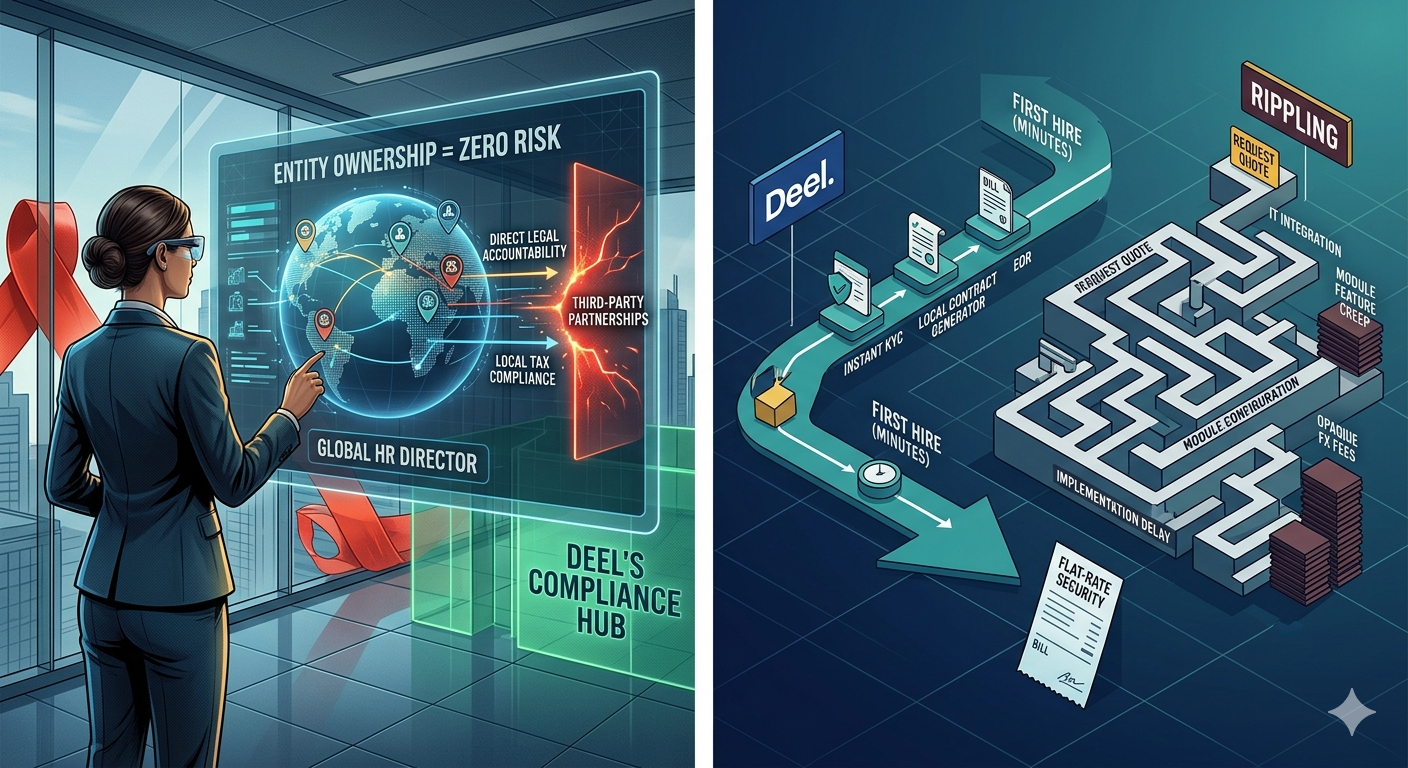
Many platforms rely heavily on third-party partners—essentially outsourcing your compliance to local agencies. This creates a dangerous “telephone game” of legal liability. Deel has aggressively invested in establishing over 150 wholly-owned entities worldwide. This means Deel is the legal entity in almost every market you want to enter. There are no middlemen. This infrastructure gap translates to direct, unbroken legal accountability, faster visa processing, and complete protection against permanent establishment risk. Deel owns the pipes, which means your legal standing is leak-proof.
Decoding Hidden Compliance Costs: Why “All-in-One” Isn’t Always Cheaper
A common trap for growing enterprises is falling for the allure of a sprawling, modular “all-in-one” ecosystem, only to be ambushed by opaque pricing. Rippling’s modular pricing structure—where you pay separately for the core platform, the HR module, the IT module, and various add-ons—creates massive “feature creep.” What starts as an $8-per-user baseline quickly spirals out of control when custom integrations and compliance add-ons are tallied at the end of the billing cycle.
Deel champions radical transparency. Its pricing is straightforward, with clear, flat rates for EOR and contractor management. There are no hidden fees lurking behind mandatory implementation packages or surprise module requirements. When forecasting your 2026 budget, Deel allows you to model your scaling costs with absolute mathematical certainty, ensuring that your capital is spent on talent, not software overhead.
Misclassification Insurance: How Deel Shields You from 2026 Labor Audits
Governments worldwide are fiercely cracking down on contractor misclassification, handing out devastating penalties to companies treating independent contractors like full-time employees. In 2026, standard compliance checks are no longer enough.
Deel has completely changed the game with its embedded Compliance Hub and AI Worker Classifier. Utilizing a proprietary combination of AI and award-winning research into global employment court cases, Deel proactively assesses the legal status of your hires in real-time. It catches anomalies and flags risks before a contract is even signed. More importantly, Deel offers robust misclassification protections and liability coverage. While competitors rely on reactive alerts, Deel’s proactive shield actively defends your company against audits, saving you from fines that can easily wipe out a quarter’s profit.
Global Payroll Precision: Handling 100+ Currencies Without Hidden FX Fees
Running payroll across dozens of borders usually involves a chaotic web of local banks, shadow FX fees, and delayed SWIFT transfers. For employees, nothing is more demoralizing than receiving their salary late or seeing it eaten alive by terrible exchange rates.
Deel processes over $7 billion in global payments, supporting more than 150 currencies—including localized direct deposits and crypto options. Deel’s proprietary payroll engine, fortified by the acquisition of PaySpace, executes payments with unmatched precision. It handles all mandatory local benefits, health insurance, pensions, and localized tax withholdings natively. The result is a frictionless, accurate payroll cycle every single month, bypassing the hidden FX fees and processing delays that plague legacy systems.
The Speed of Entry: Why Deel’s Onboarding Beats Rippling’s Implementation
In the fast-paced SaaS and tech sectors, “Time to Hire” is a critical financial metric. If an elite engineer accepts your offer, you cannot afford a three-week administrative delay to get them working.
Rippling’s implementation is notoriously heavy. Because it attempts to wire into every facet of your internal IT and finance stack, getting the system live requires extensive setup, custom quotes, and ongoing admin tweaking. Deel is built for velocity. Because Deel leverages its wholly-owned global infrastructure, you can onboard a new hire in a new country in a matter of minutes. From background checks to local compliance verification, Deel’s automated onboarding workflows ensure that your new talent is ready to push code or close deals immediately.
Localized Contracts: Automated Legal Updates You Don’t Have to Track
Labor laws change constantly. Tracking statutory benefits in Germany, termination protocols in Brazil, and overtime rules in Japan is an impossible task for a centralized HR team.
Deel completely automates this burden. Its platform features a localized contract generator that dynamically updates based on real-time changes to local legislation. You simply input the role and the salary, and Deel’s engine generates a watertight, fully compliant agreement instantly. You do not need to retain external counsel in 50 different countries. Deel’s in-house legal experts and continuous compliance monitoring ensure that every contract you issue is bulletproof at the moment of signing.
Scaling Without Friction: How Deel Simplifies Intellectual Property Protection
When hiring global contractors and EOR employees, securing your intellectual property (IP) is paramount. If a contract is poorly drafted under a foreign jurisdiction, your company may not actually own the code or content your global team produces.
Deel’s localized agreements explicitly address IP assignment and confidentiality according to the specific legal standards of the worker’s country. It ensures that the transfer of IP rights is legally binding and enforceable, regardless of where the work is performed. This provides absolute peace of mind for engineering leads and founders—your proprietary technology remains strictly yours, without the friction of negotiating custom IP clauses for every new hire.
The User Experience: Comparing the Employer and Employee Dashboards
A platform’s adoption rate lives or dies by its user interface. When managing a remote team, the software is the physical office.
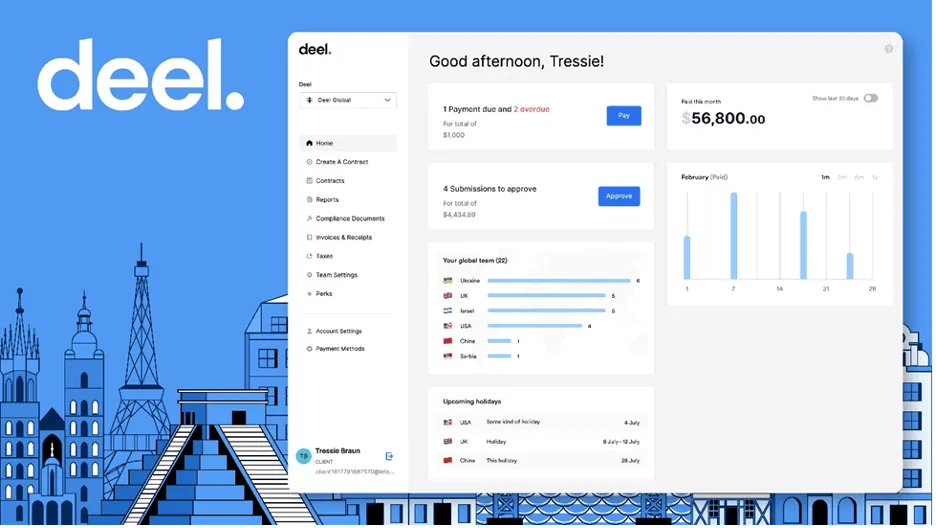
User reviews consistently highlight Rippling’s interface as cluttered and occasionally laggy, largely due to the sheer volume of modules packed into the dashboard. Finding specific compliance documents can feel like navigating a maze. Deel, conversely, is praised for its elegant, minimalist, and highly intuitive design. The employer dashboard provides a clear, actionable overview of total headcount, payroll runs, and pending tasks. For the employee, the Deel experience is flawless: they can track their equipment shipments (via Deel IT), review payslips, submit expenses, and access benefits from a single, clean mobile-friendly interface.
Pricing Transparency: Avoiding the “Feature Creep” of Modular SaaS
We must revisit pricing, as it is the most common grievance found in global HR reviews. The “All-in-One” promise often masks a strategy designed to lock you into an escalating billing cycle. A base platform fee plus a per-user HR module fee, plus an IT module fee, plus implementation fees—this is the reality of the modular SaaS model.
Deel protects your margins. By offering predictable, transparent pricing—starting at a clear flat rate for contractors and a fixed baseline for EOR employees—Deel allows you to scale predictably. You get full access to a global HR platform at a base rate that does not require a calculator to decipher. For startups and enterprises alike, this transparency prevents budget overruns and ensures a superior return on investment.
The Deel Sign-Up Process: From Account Creation to Your First Hire
Getting started with Deel is an exercise in modern software efficiency. You don’t need a series of aggressive sales calls to get off the ground.
-
Step 1: Account Creation. Visit Deel.com, click Sign Up, and select the employer portal.
-
Step 2: Instant KYC Verification. Upload your company registration details for rapid verification.
-
Step 3: Choose Your Model. Navigate the clean UI to select whether you are hiring a Contractor, utilizing the EOR service for a full-time employee, or setting up Global Payroll for your own entities.
-
Step 4: Generate and Send. Use the automated, localized contract generator to draft an agreement. Input the compensation, hit send, and your new hire receives a compliant, secure onboarding package instantly.
The Rippling Sign-Up Workflow: What to Expect Before Going Live
By contrast, Rippling requires a fundamentally different commitment. You cannot simply create an account and hire someone today.
-
Step 1: Request a Quote. Pricing is walled off; you must engage with a sales representative to build a custom package based on your exact module needs.
-
Step 2: Implementation Mapping. Because the system integrates deeply with your IT infrastructure (like Google Workspace or active directories), you must map out your internal workflows.
-
Step 3: Phased Rollout. Implementation is a heavier lift, requiring dedicated time from your internal IT and HR teams to configure the platform before you can confidently run your first global payroll cycle.
Technical Integration: API Reliability for Modern Engineering Teams
For mature companies in 2026, an HR platform must communicate seamlessly with the rest of the tech stack. Your internal systems require robust, reliable endpoints.
Deel’s Open API architecture is built for the modern engineering team. It allows your developers to programmatically automate contract creation, sync localized payroll data directly into your custom ERPs, and manage user provisioning without manual data entry. Furthermore, Deel is a certified Workday Global Payroll Cloud partner and integrates deeply with SAP, NetSuite, and BambooHR. This reliable technical infrastructure ensures that Deel works silently and perfectly in the background of your existing enterprise architecture.

The Final Verdict: Why Deel is the Superior Choice for 2026 Global Growth
When stripping away the noise, the choice between Deel and Rippling comes down to your primary objective. If you are a domestically focused company that needs a heavy IT device manager and is willing to accept complex pricing to get it, Rippling has its merits.
However, if your goal is rapid, secure, and compliant global expansion, Deel is the undisputed champion.
By owning its entities in over 150 countries, embedding AI directly into its compliance engine, and maintaining radical pricing transparency, Deel eliminates the friction of borderless hiring. It shifts the burden of global legal complexities off your shoulders entirely, allowing you to focus on what actually matters: building a world-class product.
Ready to bypass the hidden costs and build your global dream team today? Don’t let legacy infrastructure slow your 2026 momentum. Click here to book a demo or start hiring on Deel immediately, and experience the unrivaled speed of the world’s leading Global People Platform.